
Stop-and-go.
In a pharmacy drive-through line, Jennifer Light-Holets watches her vehicle inch forward, pause, then inch again. She’s there because her child has an ear infection, but her engineer’s mind is already working: idle stop technology and how it might be applied differently.
Before she pulls away, she knows what she’ll need next: her notebook.
Innovation doesn’t always start in a lab. Sometimes it starts in the in-between moments: a design review, a hallway conversation, or the drive home when a problem won’t let go.
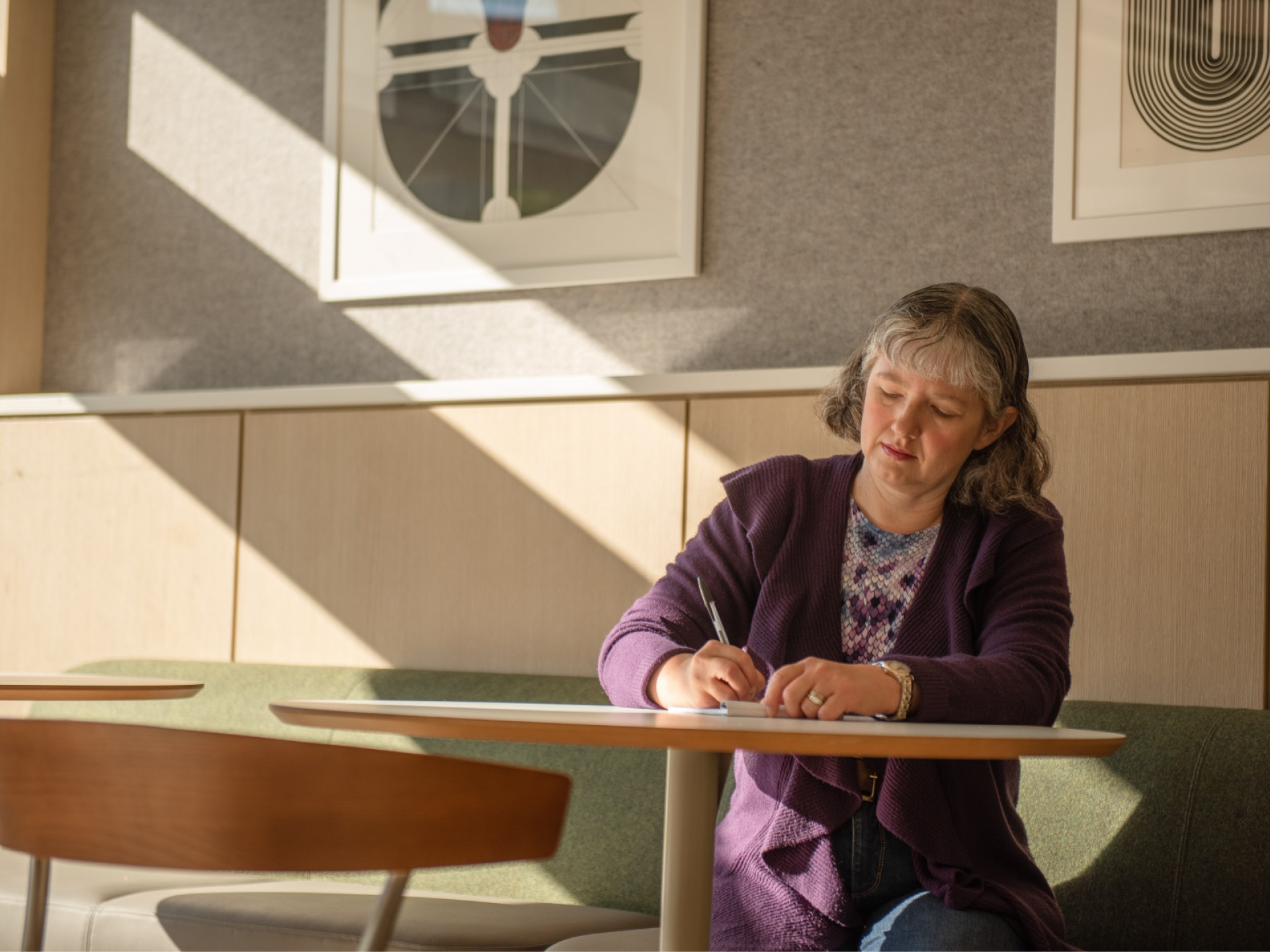
“Most of my ideas have not been sitting at a desk,” Jennifer says. When she hears a problem that’s interesting, it keeps going in the back of her mind. And she keeps a notebook close, so when a spark shows up, she can catch it before it disappears.

An inventor with 67 granted patents: The IP process
Jennifer has been with Cummins for more than 26 years. She came into the field as an electrical engineer. Today, she oversees a large portion of the company’s intellectual property portfolio, covering everything from the first invention disclosure through patenting and maintenance across the typical 20-year lifespan of a patent.
It starts with an invention disclosure. From there, ideas go to the invention review committee, where they’re evaluated for novelty and fit with the business. If an idea moves forward, patent counsel works with the inventors and filings may extend to multiple countries. Over time, the company also decides what to maintain, since patents require fees and long-term portfolio choices across the life of a patent. It’s a process Jennifer helps guide every day.
And she still invents. “You can never take an engineer away from solving problems,” she says, smiling.
Her name is on 67 granted patents and 20 pending applications. Even so, Jennifer points out that not every idea becomes a patent.
She’s had “plenty of ideas that we did not move forward with,” and she encourages others not to self-edit too early. In her view, there are no bad ideas. It’s part of the process. As part of the invention review committee, she wants to see ideas come in so good ones aren’t missed. She also emphasizes the discipline behind invention: taking the time to write an idea up and submit it, even when it’s tempting to move on to the next problem.
Often, innovation is iterative. “There’s always more things to invent on,” she says. It’s the engineer’s mindset in a sentence: keep going, keep improving, never fully satisfied with the solution.


Collaborating with innovative experts at Cummins
When Jennifer realizes there’s a missing “nugget” of expertise, something she needs to understand to move an idea forward, she goes and finds the right person. “One of the best things about being an inventor at Cummins is the level of collaboration,” she notes. “I’ve never been denied a ‘Hey, can I sit down and talk to you for 30 minutes?’”
That combination of space to think, plus access to innovative and technical experts, creates momentum. Jennifer loves to solve the problems that have not been solved yet, especially ones that let her talk with somebody and learn something new.
How different perspectives shape innovation and technology
Even after a patent expires, it can still shape what comes next, because later patents build on it, respond to it, or take it in a new direction. “If you think about it as a bibliography, I had over 450 citations of my patents at last count,” she adds. “I’ve not only had an opportunity to make an impact at Cummins, I’ve had the opportunity to make an impact in the entire industry.” Sometimes, her own inventions have been inspired by reading other patents, too. The question becomes: how do you solve the same problem in a better way?
It matters that we don’t all look at a problem the same way, Jennifer emphasizes. Unique perspectives drive invention because people bring different life experiences, and they see challenges differently. For Cummins, this “power of difference” is a business advantage that helps the company innovate and solve problems for customers.


Women in STEM: Why early mentors matter
Jennifer didn’t grow up surrounded by engineers.
“Coming from rural Indiana, I did not know a lot of women in STEM,” she says. Still, she remembers the people who nudged her forward, including a female math teacher who pushed her and a connection to a retired engineer’s daughter who helped make the path feel a little more real. “I don’t know that I necessarily looked up to somebody, but I know that I did have strong female role models encouraging me in this field.” She credits supportive teachers for motivating her to go to Purdue University and pursue engineering.
She also recalls the support she found early on at Cummins, including through a scholarship and internship program. Seeing role models and feeling that encouragement, she explains, helped her realize that even though she was underrepresented, she deserved to be there. “There was a place for me,” she says, “and people actively wanted my contributions in the engineering profession.”
That early experience shaped her view of what innovation really requires: not just ideas or expertise, but access and exposure. When you can’t point to many examples of people like you succeeding in a field, one encouraging voice can make the difference between “that’s not for me” and “maybe it is.”
Advice for the next generation of innovators
What Jennifer would tell students or early-career engineers who want to invent.
“Take the hard classes,” she says, “math, physics, chemistry, labs and don’t be afraid of failures.”
Then, she mentions the part that’s easy to overlook: show up where problems are being discussed. “Step up to the table, ask for a seat at the table. Be in the rooms where they’re talking about the challenges that are important to be solved,” she says.
Because you can’t solve problems you can’t see.
Jennifer has put that belief into practice by mentoring others who are earlier in their inventing journey.
She also led a STEM club at her children’s elementary school, running everything from classic experiments to hands-on engineering challenges. During the pandemic, she homeschooled her children for two years and, at their request for “lots of science,” turned the kitchen into a science lab. She says one of her favorite moments was watching her son build an effects pedal for his electric guitar. Jennifer even pulled out a breadboard from her old college supplies so he could prototype the electronics, she shares, amused.
She offers a message for working parents: you can’t plan every step, and careers don’t always follow a straight line. She says she didn’t set out to work in intellectual property, but staying open to change helped her grow into it.
More recently, she’s shared her inventing journey at the Cummins Women in Technology Conference and found that the real impact often happens afterward: when younger employees come up to talk, ask questions, and start imagining themselves as inventors, too.
Because innovation, at its core, is contagious.


Future-ready: the right products for customers
Future products don’t come from guessing what’s next. They come from the unsolved problems Jennifer is drawn to, and the persistence to stay with them.
Patents aren’t about what’s needed this quarter. They’re about where the company needs to be years from now. “We think in the future,” Jennifer says. Over her career, she has been involved in several waves of technological evolution at Cummins, and she’s taken pride in contributing to the work that keeps the company ahead.
Jennifer’s story is a reminder that innovation isn’t a moment. It’s a habit. And at Cummins, that habit shows up in the everyday work behind what customers count on.
And when Jennifer walks past the patent hall and sees her name alongside all the great inventors stretching back to Clessie Cummins, she feels the gratitude and the impact of contributing to what comes next.
Explore more Cummins Stories.